
Multi-Product Line Vertical Direct Buy Platform
Author: ZeMing M. Gao 高泽明, Business Architect, U.S. IP Attorney; Expert in "Company as a Product" (CaaP), Intellectual Property, Blockchain, Tokenization, and Smart Contracts (Build/Strategy/Economics); SEC/FINRA Private Securities Registered Representative; Principal Consultant at Caapable, advising multiple companies; gao@caapable.com
Current Problem
Current State: The major sub-spaces of B2B, B2C, C2C, b2C, C2B, and P2P within the commercial space are well-established, with each sub-space generally permitting only 1–2 dominant players, such as Amazon (B2C), eBay (C2C), Groupon (C2B), Facebook (P2P), Alibaba (B2B), Taobao (b2C), and JD.com (B2C).
The Gap: The M2C sub-space (Manufacturer to Consumer) alone remains fragmented, occupied only by scattered individual small operators, with no dominant player having emerged—and in particular, no mM2C (multi-M to C) platform exists.
In the traditional commercial space, M and C are insulated from each other, with no direct channel between them, making a Retailer (R) necessary as an intermediary medium. This intermediary causes enormous waste and inefficiency, yet it remains the reality. Simple direct-sales models, meanwhile, cannot achieve scale. Very few companies, like Apple, possess the market power necessary to independently open a direct commercial channel between M and C without relying on other retailers.
Without an effective M2C "interaction mechanism," M2C cannot form a major business model.
Although online sales have sparked a profound revolution over the past 30 years, product marketing remains one of the most inefficient, most directionless, most wasteful, and most objectionable areas of technology.
Nearly all past innovation and progress has occurred in "information" itself—including the creation and transmission of promotional content—rather than in the creation and construction of the space and channels through which that information travels.
In the commercial space, there is no "force field" that objectively and concretely links merchants, products, and consumers, forming a directional, targeted pipeline medium for effective transmission and management.
The current "physical characteristics" of commercial marketing space are extremely low transparency, conductivity, directionality, and controllability—incapable of producing efficient, targeted channels.
The result: current product marketing remains essentially a "megaphone" broadcast model, rather than a specific dialogue model.
Overall, across the entire product marketing space, there is a lack of a sub-physical framework and corresponding tools to construct a consumer dialogue pipeline with the following characteristics:
- Targeted interaction specific to a particular product (ranging from broad category down to an individual item)
- Commercial dialogue voluntarily and actively initiated by the consumer
Why the M2C Sub-Space Gap Exists
An M2C space with aggregation effects has yet to take shape. The connection between an individual manufacturer M and C, even where it exists, is unilateral and cannot attract large numbers of C to a manufacturer's direct-sales channel.
Individual manufacturers lack collective software and platform development capability, as well as collective market power and channel-opening capability.
At the same time, since M2C direct sales, even where they exist in the current environment, are merely a supplementary mode, manufacturers have no freedom to price independently on direct-sales websites. Bound by agreements with retailers, manufacturers cannot offer discounted prices on their own direct-sales channels even if they wish to do so (by convention, manufacturers are generally prohibited from undercutting retailers with lower prices).
In the traditional commercial space, for a manufacturer to engage in genuine direct sales, it must independently establish its own M2C commercial space through its own brand, without relying on or being constrained by other retailers.
Almost no company possesses sufficient brand power to achieve this.
Introducing the MC² Direct Sales Platform
The MC² Direct Sales Commercial Platform is the first of its kind in the M2C space, where:
M = Manufacturers
C² = Empowered Consumers
Multi-Manufacturer Vertical Direct Sales Platform
Leveraging IoT technology, "one item, one code" technology, and a proprietary asymmetric light-dark code authentication system, the platform directly connects manufacturers and consumers through physical goods, enabling truly targeted promotional channel incentives and consumer feedback—activating the EC energy (Empowered Consumer) of consumers within the commercial space.
It opens transparent and controllable closed-loop marketing channels, realizing truly targeted and positioned promotional channels of multiple types, including closed-loop systems for instant verification and redemption of coupons, rebates, prize tickets, anti-counterfeiting, and more.
Back-End Technology
- Virtual shared warehousing technology
- Bidirectional virtual account system
- Unique item code identification technology
- Dynamic transaction code generation technology
- Asymmetric masked-code authentication technology
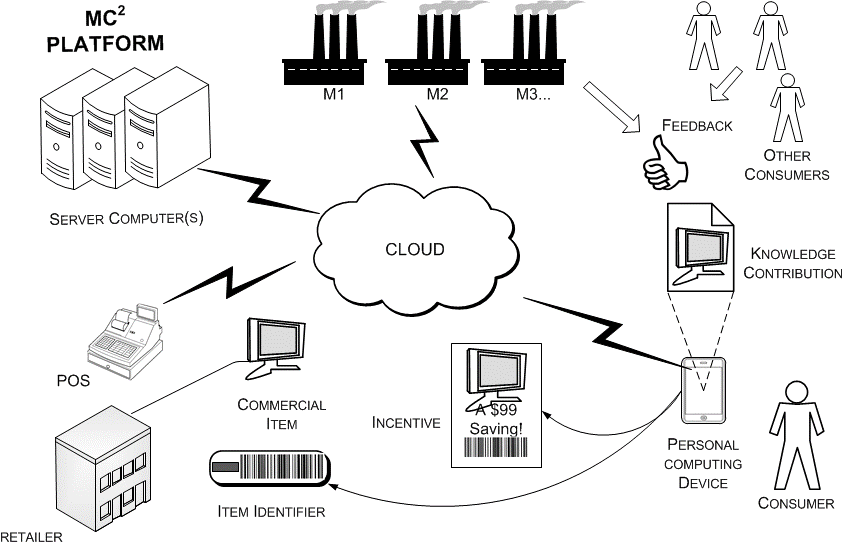

Product Promotion Technology Paired with the MC² Platform
Original "ACC Product Transaction Code Technology" (proprietary technology; details not disclosed here).
Using the innovative "item code identification system," "asymmetric light-dark code authentication system," and "dynamic transaction code generation technology," a concrete, directional, and targeted "Merchant-Product-Consumer" (MpC) pipeline is established within the marketing space, releasing the enormous reverse creativity and productivity of consumers.
Transparent and controllable closed-loop marketing channels are opened, enabling manufacturers to conduct real-time monitoring of promotional campaigns from micro to macro scale, eliminating blind and misdirected advertising.
This will impact the entire product marketing space.
An Innovative Commercial Platform
A Brand-New Multi-Manufacturer Vertical Direct Sales Platform and Paired Marketing Pipeline
- Original "multi-manufacturer vertical direct sales platform"
- Opens transparent and controllable closed-loop marketing channels
- Creates an "intention economy" ecosystem, incentivizing and releasing the enormous reverse creativity and productivity of consumers; activates the "Manufacturer-Product-Consumer Interactive Force (MpC Interactive Force)" in the commercial space, increasing and releasing the energy of manufacturers and consumers within the commercial space
- Dramatically enhances the power and effectiveness of marketing instruments – incomparable to existing methods
- Back-End Technology – built upon and secured by multiple proprietary patented technologies including "virtual shared warehousing technology," "bidirectional virtual account system," "unique item code identification technology," "dynamic transaction code generation technology," and "asymmetric masked-code authentication technology"; cannot be effectively replicated or achieved through existing technologies.
Current Timing
Chinese manufacturers urgently need to enter the U.S. market, but struggle to find a foothold in traditional American retail—unable to find an entry point, establish a path, or build their own brands.
Combined with exclusive anti-counterfeiting technology, the MC² Platform will provide Chinese manufacturers and brands with a historic "bypass" opportunity for direct entry into the U.S. market.
In the United States, the market and IT infrastructure—especially e-commerce infrastructure, including cloud technology, warehousing technology, logistics, and platform integration technology—have matured to exactly the right degree. Now is the optimal moment to develop the MC² Platform.
Potential Market: The global marketing channel market, unrestricted by product category—any marketing market that needs or can benefit from a "Manufacturer-Product-Consumer" (MpC) interactive pipeline, whether online, offline, or otherwise, falls within the scope of the MC² Platform.
Direct Sales Market: The MC² Platform opens a multi-manufacturer direct sales market within the M2C sub-space.
The potential market scale of the MC² Platform's direct sales services is immeasurable.
MC² Platform direct sales are not limited to online shopping. The platform's core is e-commerce, but through patent-protected "unique item code identification technology," "dynamic code generation technology," and "asymmetric masked-code authentication technology," as well as mature mobile application technology (Mobile App), this space can extend into physical stores.
Physical stores on the MC² Platform may be traditional retail stores, or they may realize "Online-to-Offline Hybrid Stores" (O2O Hybrid Store).
Enormous Product Marketing Market – Beyond direct sales platform services, the MC² Platform will capture a vast marketing and promotional market, including targeted advertising and personalized promotional instruments such as coupons, rebates, prize tickets, and anti-counterfeiting measures.
Data: Traditional marketing expenditure (spending) accounts for 10%–70% of total industry sales, proportional to the industry's mark-up rate; in a typical product industry, the mark-up rate is 3x (i.e., the retail price is three times the factory price), and marketing expenditure accounts for approximately 30–50% of total industry sales.
2012 retail market scale: United States $3.39 trillion; China $2.3 trillion; Japan $1.7 trillion; other markets approaching the trillion-dollar scale include: India ($850 billion), Russia ($650 billion), and Brazil ($500 billion).
Total marketing expenditure (i.e., the market scale of the marketing services industry), calculated at a baseline of 10%, is approximately: United States $340 billion; China $230 billion; India $85 billion.
A Revolution Facing the Product Space
Beyond the direct sales revolution in the M2C space, the MC² Platform will simultaneously spark a widespread product promotion revolution.
Product marketing has already undergone one revolution over the past thirty years, driven by IT technology—especially the Internet—which brought about a profound transformation in that time.
Yet product marketing remains one of the most inefficient, most directionless, most wasteful, and most objectionable areas of technology.
The MC² Platform will trigger an even more significant revolution in the product marketing industry.
Why are current product marketing methods inefficient and directionless?
Nearly all past innovation and progress has occurred in "information" itself—including the creation and transmission of promotional content—rather than in the creation and construction of the space and channels through which that information travels.
In the commercial space, there is no "force field" that objectively and concretely links merchants, products, and consumers, forming a directional, targeted pipeline medium for effective transmission and management.
The current "physical characteristics" of commercial marketing space are extremely low transparency, conductivity, directionality, and controllability—incapable of producing efficient, targeted channels.
The result: Current product marketing remains essentially a "megaphone" broadcast model, rather than a specific dialogue model.
Overall, across the entire product marketing space, there is a lack of a sub-physical framework and corresponding tools to construct a consumer dialogue pipeline with the following characteristics:
- Targeted interaction specific to a particular product (ranging from broad category down to an individual item)
- Commercial dialogue voluntarily and actively initiated by the consumer
The Root of the Problem
First: In the current commercial space, manufacturers have virtually no visibility or control over products that have already left the factory and entered the market.
- Beyond macro-level market feedback information and some broad-scale price adjustments, manufacturers have no controlling capability whatsoever.
Second: At the same time, the existing connections between manufacturers and consumers have the following characteristics:
- Weak and thin
- Disconnected from specific products
- One-way manufacturer broadcasting, met with consumer indifference or even aversion
In short, there is no concrete, directional, targeted, pipeline-style "Merchant-Product-Consumer" (MpC) medium.
The above problems are not a matter of how hard a manufacturer tries, nor are they simply a management issue.
Rather, they are:
- An objective mechanism problem
- A "physics" problem within commercial space
- A commercial engineering problem
- Also a technology problem
The Distinctiveness and Advantages of ACC Product Transaction Code Technology
Coupons, rebate vouchers, prize tickets, lottery tickets, and anti-counterfeiting measures are the strongest "force fields" in commercial space, attracting consumers. But due to the lack of a concrete, directional, targeted, pipeline-style "Merchant-Product-Consumer" medium, merchants in the past could only cast wide nets blindly at the consumer end—without a specific "one item, one person" channel, without an authentication function, and without a systemic control mechanism that adapts in real time.
By contrast, the "one item, one code ACC authentication" system comprehensively revolutionizes the current paradigm, offering a range of important functions.
Opening and Activating a Specific "One Item, One Person" Channel
What the MC² Platform opens is a bidirectional channel on which a single "original information exchange" occurs first, which is then recorded in the system and can generate secondary value.
Although this "original exchange" occurs only once, its specificity alone makes it revolutionary; the commercial energy it generates is incalculable.
This specificity is the fundamental prerequisite for achieving controllable, personalized promotion: for example, the same product might give Consumer A a 10% discount, give Consumer B a free unit, and give Consumer C a free unit plus a gift—appearing random from the consumer's subjective perspective (thus generating excitement) while remaining globally controllable in the manufacturer's hands (thus having commercial value).
Micro-level randomness, macro-level controllability—this is what every manufacturer dreams of.
Guaranteeing the Reliability and Authenticity of This Channel and the "Consumer Motivation" That Accompanies It
In other words, "incentive elements" associated with this motivation—such as coupons, rebate vouchers, and prize tickets—cannot be forged or deciphered. This is a concept broader than product anti-counterfeiting itself.
Coupons – Can resolve a long-standing headache for promoters and retailers: in traditional methods, retailers often cannot confirm whether a consumer-submitted coupon is valid; at the same time, retailers frequently apply promoters' coupons proactively or automatically after a consumer has already selected a product, rendering the coupon ineffective as a true promotional incentive.
Rebates – Can also resolve a long-standing headache for promoters and consumers: in traditional methods, rebates are often impractical to implement because verifying the purchase is too cumbersome.
Prize Tickets and Lottery Tickets – The "one item, one code ACC authentication" system can solve at one stroke a major problem with traditional methods: the lack of convenience and immediacy in prize and lottery ticket verification.
Realizing a Systemic Control Mechanism That Allows Manufacturers to Adapt in Real Time Based on Sales Conditions and Other Business Needs
On currently prevalent commercial platforms, this kind of systemic control is impossible.
Under current practice, manufacturers can only make a one-time decision regarding product sales based on prior forecasting; promotional activities after a product has entered the sales channel can only be carried out by casting nets—distributing coupons and the like.
Traditional coupons